NUTRITION SYSTEMS
WHY MOST FAT LOSS DIETS FAIL
Fat loss fails when motivation replaces structure and sustainability.
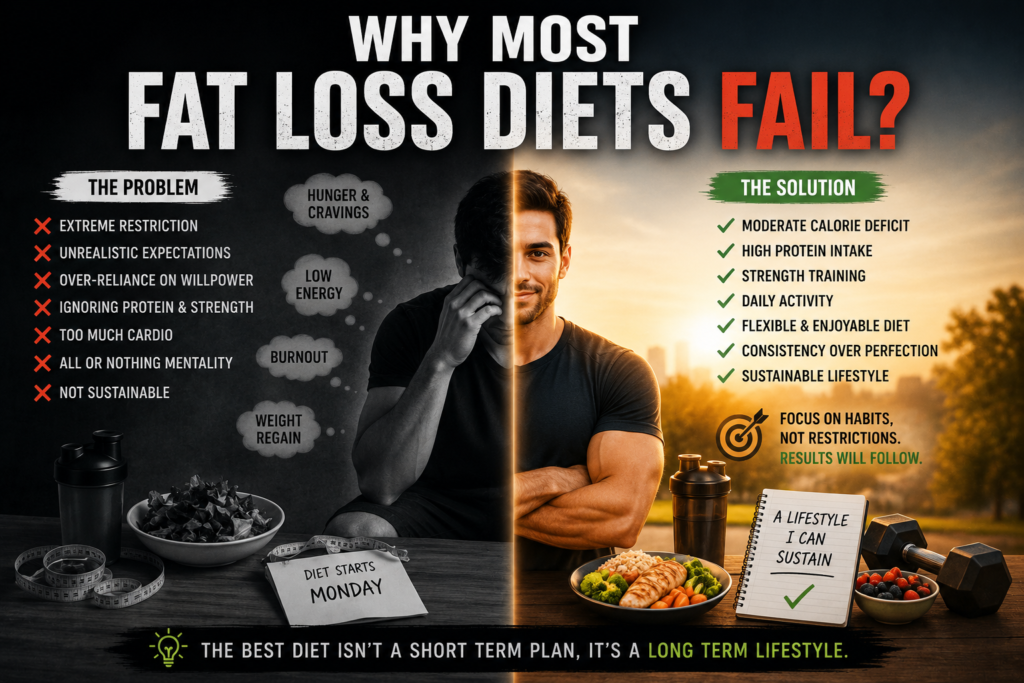
Every year, millions of people start a new fat loss diet with extreme motivation.
They cut carbs.
Skip meals.
Do endless cardio.
Track every calorie.
For a few weeks, the scale drops.
Then suddenly:
- Energy crashes
- Hunger increases
- Cravings become uncontrollable
- Motivation disappears
- Weight returns
Sometimes even worse than before.
So why does this happen?
The truth is:
Most fat loss diets fail because they are built for short-term suffering, not long-term sustainability.
Fat Loss Is Simple — But Not Easy
At its core, fat loss happens when:
You consistently burn more calories than you consume.
But while the science is simple, human behavior is not.
Most people fail not because fat loss is impossible — but because their approach is unrealistic.
1. People Choose Extreme Diets
One of the biggest reasons diets fail is unnecessary restriction.
Examples:
- Starving yourself
- Cutting entire food groups
- Eating extremely low calories
- Following “detox” plans
- Surviving on salads and smoothies
Extreme approaches create:
- Intense hunger
- Low energy
- Hormonal stress
- Mood swings
- Muscle loss
- Poor recovery
Eventually the body fights back.
And when binge eating starts, people blame themselves instead of the diet.
2. Diets Ignore Human Psychology
A diet may look perfect on paper.
But if you hate every day of it, you won’t sustain it.
Most people try to rely only on:
- Motivation
- Discipline
- Willpower
But willpower is temporary.
Successful fat loss requires:
- Habits
- Routine
- Enjoyable foods
- Flexibility
- Sustainability
The best diet is not the fastest one.
It’s the one you can follow consistently for months and years.
3. People Lose Weight Too Fast
Rapid weight loss often comes from:
- Water loss
- Glycogen depletion
- Muscle loss
Not just fat.
Losing weight too aggressively slows metabolism and increases fatigue.
This leads to:
- Plateau
- Hunger spikes
- Reduced training performance
- Lower daily activity
- Rebound weight gain
Sustainable fat loss is slower than social media makes it look.
4. Lack Of Protein And Resistance Training
Many people focus only on eating less.
But without proper training and protein intake, the body loses muscle along with fat.
This creates the “skinny-fat” look:
- Smaller body
- Low muscle definition
- Weak metabolism
- Poor physique quality
Muscle is critical during fat loss because it helps:
- Maintain metabolism
- Improve body composition
- Enhance strength
- Create a leaner appearance
Fat loss should not just make you lighter.
It should make you look and perform better.
5. Unrealistic Expectations
Social media has destroyed patience.
People expect:
- 10 kg loss in 2 weeks
- Visible abs in a month
- Instant transformations
Real fat loss takes time.
Healthy progress often looks like:
- 0.5–1% bodyweight loss per week
- Small daily improvements
- Consistency over intensity
Most people quit because results are slower than expected — even when progress is actually happening.
6. They Depend Too Much On Cardio
Cardio can help fat loss.
But excessive cardio combined with severe dieting often leads to:
- Burnout
- Muscle loss
- Fatigue
- Increased appetite
You cannot out-cardio a poor diet.
The foundation of sustainable fat loss should be:
- Nutrition
- Strength training
- Sleep
- Recovery
- Activity levels
Cardio is a tool — not the entire solution.
7. “All Or Nothing” Mentality
This mindset destroys long-term progress.
Example:
- One cheat meal → “Diet ruined”
- Miss one workout → “I’ll restart Monday”
Fat loss success comes from consistency, not perfection.
One bad meal does not ruin progress.
But quitting entirely does.
8. Most Diets Don’t Teach Lifestyle Change
Temporary diets create temporary results.
If your old habits return after the diet ends, the weight usually returns too.
Real transformation requires:
- Better eating habits
- Better sleep
- Better stress management
- Better activity patterns
- Better relationship with food
Fat loss should eventually become part of your lifestyle — not a punishment phase.
The Science Behind Rebound Weight Gain
When calories drop too low for too long, the body adapts by:
- Increasing hunger hormones
- Reducing energy expenditure
- Lowering movement subconsciously
- Increasing cravings
- Slowing metabolic efficiency
This is your body trying to survive.
That’s why extremely restrictive diets often end with:
- Overeating
- Rapid regain
- Frustration
- Another cycle of dieting
This cycle is called:
“Yo-Yo Dieting”
And it’s one of the biggest reasons people stay stuck for years.
What Actually Works For Sustainable Fat Loss
- Moderate Calorie Deficit -> Not Starvation
- Strength Training -> Builds a stronger, leaner physique.
- High Protein Intake -> Helps preserve muscle and reduce hunger.
- Flexible Dieting -> You should still enjoy food while making progress.
- Daily Activity -> Walking and staying active matter more than most people think.
- Consistency Over Perfection -> The best results come from habits repeated over time.
Most fat loss diets fail because they focus only on short-term results.
But real transformation is about creating a lifestyle you can maintain permanently.
The goal shouldn’t be:
“How fast can I lose weight?”
The better question is:
“Can I realistically live like this long term?”
Because sustainable fat loss is not built through punishment.
It’s built through consistency, balance, and habits you can actually maintain.
KEY TAKEAWAYS
- The best fat loss diet is the one you can sustain without destroying your energy, health, or happiness.