EXERCISE MECHANICS
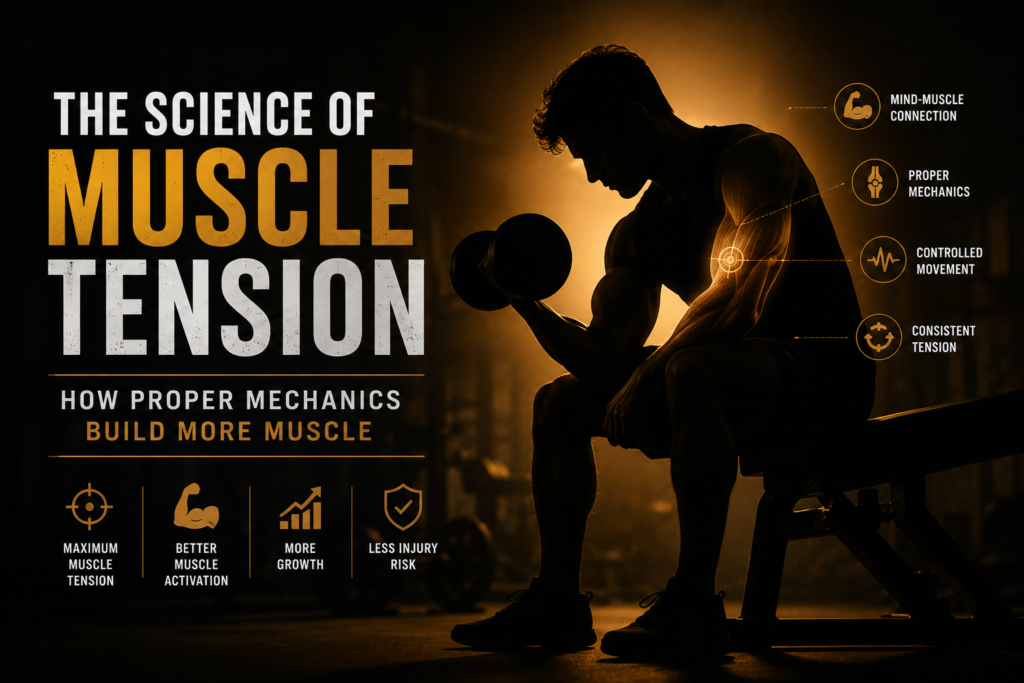
The Science Of Muscle TensionHow Proper Mechanics Build More Muscle
Control the movement, maximize the tension, and force your muscles to grow through precision instead of ego lifting.
Most people believe muscle growth is all about:
- Lifting heavier weights
- Doing more exercises
- Training harder
But one of the biggest drivers of muscle growth is something many people completely ignore:
Muscle tension.
You can lift heavy weights for years and still fail to maximize muscle growth if the target muscle isn’t experiencing proper tension.
That’s where exercise mechanics become important.
Because muscles don’t understand:
- Ego
- Momentum
- Weight on the bar
They only respond to:
Mechanical tension and effective stimulus.
1. What Is Muscle Tension?
Muscle tension refers to the force produced within a muscle while it contracts under resistance.
In simpler terms:
It’s how hard the muscle is being forced to work.
The greater the effective tension placed on a muscle — especially through controlled movement — the stronger the muscle-building signal becomes.
This is one of the primary drivers of hypertrophy (muscle growth).
2. Why Proper Mechanics Matter?
Exercise mechanics determine:
- Which muscle receives the tension
- How efficiently force is produced
- Joint positioning during movement
- Range of motion quality
- Injury risk
Poor mechanics often shift tension away from the target muscle and into:
- Momentum
- Joints
- Supporting muscles
This reduces growth stimulus dramatically.
3. More Weight Doesn’t Always Mean More Growth
One of the biggest mistakes in the gym is ego lifting.
Example:
A person performs heavy barbell curls using:
- Excessive swinging
- Lower back momentum
- Partial range of motion
The weight moves.
But the biceps receive less effective tension.
Now compare that to:
- Controlled reps
- Full range of motion
- Stable posture
- Constant muscular tension
Even with lighter weight, the muscle often works harder.
4. The Role Of Controlled Movement
Control increases muscular loading.
When you control:
- The lifting phase
- The lowering phase
- The stretch position
…you maximize tension throughout the movement.
Especially important is the eccentric phase:
The lowering portion of a rep.
Research consistently shows controlled eccentrics create strong hypertrophy stimulus.
5. Range Of Motion And Muscle Growth
A muscle grows best when trained through meaningful ranges of motion.
Partial reps have their place.
But constantly shortening movements reduces:
- Stretch stimulus
- Fiber recruitment
- Total muscular loading
Proper mechanics usually involve:
- Stability
- Control
- Full usable range of motion
- Consistent tension
Not simply moving weight from point A to B.
6. Momentum Reduces Muscle Tension
Momentum is one of the biggest tension killers.
When momentum takes over:
- The target muscle works less
- Other structures absorb force
- The exercise becomes less efficient
This is why:
- Slow, controlled reps often feel harder
- Lightweight exercises can create intense stimulus
- Proper execution outperforms sloppy lifting
The goal is not to make the exercise easier.
The goal is to make the muscle work harder.
7. Mind-Muscle Connection Matters
Mind-muscle connection refers to consciously focusing on the target muscle during training.
This improves:
- Muscle activation
- Tension quality
- Exercise efficiency
People who simply “move weight” often miss this completely.
The best lifters don’t just lift weights.
They direct tension intentionally.
8. Stability Creates Better Force Production
The body produces force best from stable positions.
This is why proper setup matters:
- Foot positioning
- Joint alignment
- Bracing
- Posture
- Grip mechanics
Poor stability leaks force.
Better stability improves:
- Muscle recruitment
- Safety
- Strength output
- Tension quality
9. The Stretch Position Is Extremely Powerful
Modern hypertrophy research strongly supports loaded stretch training.
Exercises that challenge muscles in stretched positions often create massive growth stimulus.
Examples:
- Deep Romanian deadlifts
- Incline dumbbell curls
- Deep chest fly variations
- Bulgarian split squats
The stretched position places high tension on muscle fibers, increasing adaptation signals.
10. Proper Mechanics Reduce Injury Risk
Bad mechanics overload joints instead of muscles.
This increases:
- Wear and tear
- Pain
- Compensation patterns
- Injury probability
Good mechanics help distribute force properly across tissues.
This allows:
- Better recovery
- Longer training lifespan
- More consistent progress
Because the best training program is the one you can sustain injury-free.
11. Quality Over Quantity
Doing more exercises doesn’t always mean better results.
Often:
- Fewer exercises
- Better execution
- Higher tension quality
produces superior muscle growth.
One perfectly executed set can outperform multiple sloppy sets.
How To Improve Exercise Mechanics
- Slow Down Your Reps -> Control every phase of movement.
- Stop Ego Lifting -> Use weights you can actually control.
- Focus On The Target Muscle -> Don’t just move the weight. Feel the muscle working.
- Improve Stability -> Stable positions create stronger contractions.
- Train Through Proper Range Of Motion -> Maximize stretch and tension safely.
- Record Your Form -> Video analysis helps identify mechanical flaws quickly.
Conclusion
Muscle growth is not just about lifting heavier.
It’s about creating the highest quality muscular tension possible.
The best physiques are rarely built by:
- Random movement
- Ego lifting
- Excessive momentum
They are built through:
- Precision
- Control
- Proper mechanics
- Consistent tension
Because in the end:
Muscles grow based on the quality of stimulus — not the amount of ego involved.
KEY TAKEAWAYS
- The goal of training is not to move the weight.
- The goal is to make the muscle do the work.