RACE PREPARATION
HYROX Training Guide: Everything You Need to Know to Prepare for the Ultimate Fitness Race
Running meets strength. Endurance meets power. And fitness meets performance.

Thinking about taking on the HYROX Race?
HYROX is not just another fitness competition. It is a test of how well your body can combine cardiovascular endurance, muscular strength, muscular endurance and mental resilience under fatigue. Whether you’re a beginner looking to participate in your first HYROX event or an experienced athlete aiming to improve your finishing time, preparing for HYROX requires a structured approach.In this guide, we’ll explore the competition format, physical demands, essential exercises, training structure, nutrition, recovery and race-day strategy to help you prepare effectively.
1. What Is HYROX?
HYROX is an international fitness racing competition that combines running with functional workout stations.
It brings together two important aspects of athletic performance:
Endurance: The ability to sustain physical activity over an extended period.
Functional strength: The ability to produce and sustain force through practical movements such as pushing, pulling, carrying, rowing and lunging.
Unlike a conventional marathon or strength competition, HYROX requires participants to repeatedly transition between running and functional exercises. One of the most interesting aspects of HYROX is its standardized race format, allowing athletes from different countries to compete on the same fundamental course structure.
The HYROX race format
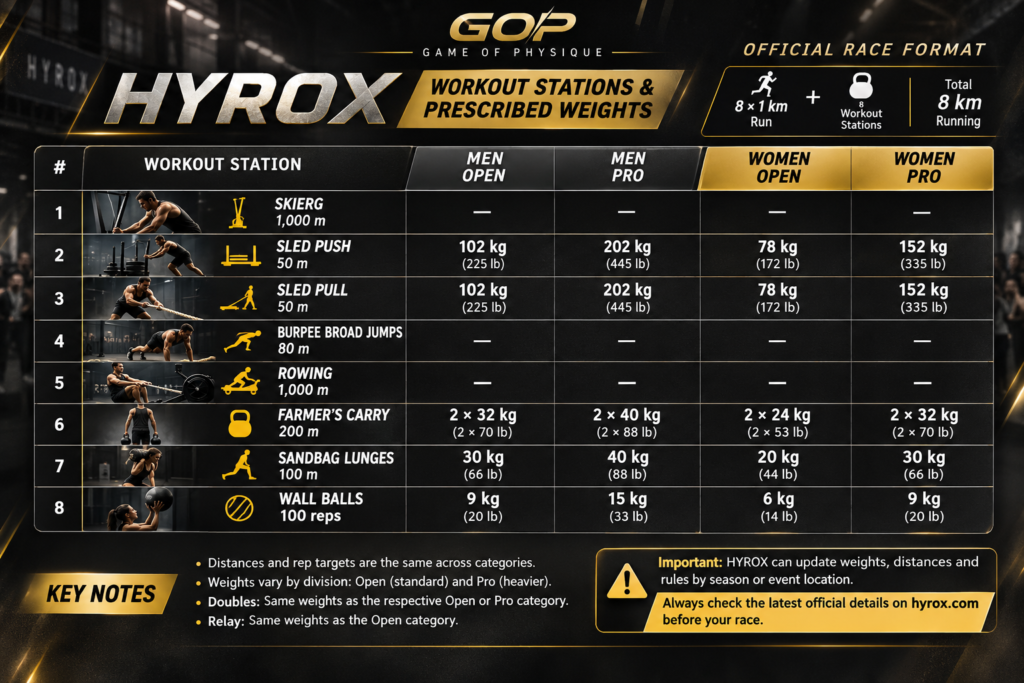
A standard individual HYROX race consists of:
8 Km total running distance – 8 × 1 km runs & 8 workout stations completed in a fixed order.
The format follows a simple pattern:
1 km Run → Workout Station → 1 km Run → Workout Station
This sequence continues until all eight running segments and eight workout stations are completed.
2. The Eight HYROX Workout Stations
Understanding each station is essential before designing your training program.
a. SkiErg(1,000 metres): Primarily challenges the upper body, lats, shoulders, triceps and core, while requiring coordinated lower-body involvement.
Training focus: Cardiovascular endurance, lat strength, core stability and movement efficiency.
b.Sled Push(50 metres): Requires athletes to drive a weighted sled across the designated distance.
Training focus: Quadriceps, glutes, calves, core bracing and horizontal force production.
c. Sled Pull(50 metres): Involves pulling a loaded sled using a rope while maintaining body position and generating force.
Training focus: Back, biceps, grip strength, posterior chain and core stability.
d. Burpee Broad Jumps(80 metres): Combines repeated burpees with forward horizontal jumps.
Training focus: Muscular endurance, explosive power, coordination and cardiovascular conditioning.
e. Rowing(1,000 metres): A full-body conditioning movement requiring coordinated leg drive, trunk movement and upper-body pulling.
Training focus: Aerobic capacity, posterior chain, legs, back and core.
f. Farmer’s Carry(200 metres): Athletes carry two kettlebells over the prescribed distance.
Training focus: Grip strength, traps, core stability, postural endurance and walking capacity.
g. Sandbag Lunges(100 metres): Requires repeated lunges while carrying a sandbag on the back.
Training focus: Quadriceps, glutes, hamstrings, unilateral strength and muscular endurance.
h. Wall Balls(100 repetitions): Athletes perform repeated squats followed by throwing a medicine ball towards a designated target.
Training focus: Lower-body muscular endurance, shoulder endurance, coordination and breathing control.
These are the standard individual race distances and station order. Prescribed loads, target heights and other movement standards vary by division. Always consult the current event rulebook.
3. What Physical Qualities Does HYROX Test?
HYROX is not simply a strength competition or an endurance race. It tests several physical qualities simultaneously.
A. Aerobic endurance
Your aerobic energy system supports sustained activity and helps you recover between high-intensity efforts.
Develop it through:
-
Zone 2 running
-
Long-distance running
-
Steady-state rowing
-
SkiErg conditioning
-
Controlled aerobic circuits
B. Muscular strength
You need sufficient strength to move external resistance efficiently.
Prioritize:
-
Squats
-
Deadlifts
-
Lunges
-
Rows
-
Pulling variations
-
Sled pushes and pulls
C. Muscular endurance
Performing 100 wall balls after running several kilometres requires your muscles to repeatedly generate force despite accumulated fatigue.
Develop this through:
-
Higher-repetition resistance training
-
Loaded carries
-
Walking lunges
-
Wall balls
-
Functional circuits
D. Anaerobic capacity
Sled pushes, burpee broad jumps and other demanding stations can require high rates of energy production.
Train with:
-
Short intervals
-
Sled pushes
-
Assault bike intervals
-
Burpee variations
-
High-intensity rowing
E. Core stability
Your core transfers force between your upper and lower body.
Prioritize:
-
Planks
-
Pallof presses
-
Farmer carries
-
Dead bugs
-
Loaded carries
-
Anti-rotation exercises
F. Mental resilience
HYROX requires you to continue performing when your legs are fatigued, breathing is elevated and your muscles are working hard.
Learning to pace yourself and maintain movement efficiency is just as important as developing physical strength.
4. How Long Should You Train for HYROX?
Your preparation period should depend on your existing fitness level.
| Fitness level | Suggested preparation |
|---|---|
| Beginner | 12–16 weeks |
| Intermediate | 8–12 weeks |
| Advanced | 6–8 weeks |
These are practical planning ranges, not official HYROX requirements.
Beginners: Develop running consistency, foundational strength and basic movement proficiency.
Intermediate athletes: Improve running pace, strength endurance and station-specific performance.
Advanced athletes: Focus on race simulations, pacing, transitions and individual weaknesses.
If you have limited running experience, allow additional time to build your aerobic base before increasing race-specific intensity.
5. How to Train for HYROX: The Essential Exercises
Your gym training should directly support the physical demands of the eight stations.
Lower-body strength
Prioritize:
- Back squats
- Front squats
- Romanian deadlifts
- Walking lunges
- Bulgarian split squats
- Step-ups
- Sled pushes
Prioritize:
- Seated cable rows
- Lat pulldowns
- Pull-ups
- Dumbbell shoulder presses
- Push-ups
- Rope pulls
- Triceps exercises
Prioritize:
- Farmer carries
- Wall balls
- Burpee broad jumps
- Rowing
- SkiErg
- Sandbag lunges
- Sled work
The goal is not to train every exercise to exhaustion. It is to develop the capacity to perform each movement efficiently and repeatedly.
6. Sample 7-Day HYROX Training Schedule
A balanced weekly training structure should develop running endurance, strength, muscular endurance and race-specific conditioning without accumulating excessive fatigue.
| Day | Training focus |
|---|---|
| Monday | Zone 2 run + mobility |
| Tuesday | Lower-body strength + sled push |
| Wednesday | Running intervals + SkiErg |
| Thursday | Upper-body strength + grip |
| Friday | Functional conditioning + rowing |
| Saturday | HYROX-specific simulation |
| Sunday | Active recovery / rest |
Example HYROX conditioning workout
3–4 rounds:
| Exercise | Distance / reps |
|---|---|
| Run | 800 m |
| SkiErg | 500 m |
| Sled push | 25 m |
| Sled pull | 25 m |
| Burpees | 10 |
| Farmer’s carry | 50 m |
| Walking lunges | 20 reps |
| Wall balls | 20 reps |
Rest between rounds as needed. This is a training circuit, not an official HYROX race simulation. Adjust the volume according to your fitness level. As your conditioning improves, gradually increase the running distance, station volume and ability to transition between exercises.
Important: You do not need to perform a complete race simulation every week. High-volume simulations can create considerable fatigue and should be programmed strategically.
7. Running Strategy for HYROX
Running accounts for 8 kilometres of the individual race, making it one of the most important components of preparation. However, running 8 kilometres continuously and running 8 kilometres interrupted by demanding functional exercises are two different challenges. Your legs will experience accumulated fatigue from sled pushes, lunges, burpees and other stations.
Three types of running you should include
1. Zone 2 running
Develops aerobic capacity and improves your ability to sustain prolonged activity.
Duration: 30–60 minutes
Intensity: Conversational pace
Frequency: 1–2 sessions weekly
2. Interval running
Improves your ability to run at higher intensities.
Example:
5 × 800 m
Controlled recovery between intervals
Maintain consistent pacing
3. Compromised running
This is particularly important for HYROX. Compromised running means running immediately after performing a demanding exercise.
Example:
500 m SkiErg
500 m run
25 m sled push
500 m run
20 walking lunges
500 m run
This teaches your body to maintain running mechanics when your muscles are already fatigued.
8. Understanding HYROX Divisions
HYROX offers different competition categories to accommodate different experience levels and team formats.
| Division | Format |
|---|---|
| Singles Open | Individual competition |
| Singles Pro | Individual competition with heavier loads |
| Doubles | Two athletes share workout stations |
| Doubles Pro | Two athletes with heavier prescribed loads |
| Relay | Four-person team shares the race |
In Doubles, both athletes complete the running sections together and share the workout station workload according to competition rules.
In Relay, four team members divide the race, with each completing two running segments and two workout stations.
The best division depends on your experience, fitness and competition objectives.
9. Nutrition for HYROX Preparation
Your nutrition can significantly influence your training quality, recovery and race performance. HYROX preparation involves substantial endurance and resistance training. Therefore, your nutritional strategy should support both.
Protein
Protein supports muscle repair and adaptation. A practical starting range for many active athletes is: 1.6–2.2 g of protein per kg of body weight daily.
Sources include:
-
Paneer
-
Milk and curd
-
Whey protein
-
Greek yoghurt
-
Tofu
-
Soy products
-
Legumes
Carbohydrates
Carbohydrates are particularly important for repeated high-intensity exercise. They help replenish muscle glycogen and support running, rowing, sled work and other demanding activities.
Sources include:
-
Rice
-
Oats
-
Potatoes
-
Bananas
-
Fruits
-
Whole grains
Carbohydrate requirements should be adjusted according to training volume, body weight and individual goals.
Dietary fats
Dietary fats support normal hormonal function, cell membranes and overall health.
Include:
-
Nuts
-
Seeds
-
Olive oil
-
Dairy
-
Other unsaturated fat sources
Hydration and electrolytes
Sweating during prolonged training results in fluid and electrolyte losses.
Pay attention to:
-
Fluid intake
-
Sodium replacement when appropriate
-
Training environment
-
Sweat rate
-
Exercise duration
Practice your hydration strategy during training rather than experimenting on race day.
10. Recovery and Injury Prevention
HYROX places considerable stress on the lower body, upper body and cardiovascular system. Combining high-volume running with resistance training requires careful load management.
Prioritize the following:
Sleep: Aim for 7–9 hours per night.
Mobility: Maintain ankle, hip, thoracic spine and shoulder mobility.
Strength balance: Train both anterior and posterior muscle groups.
Running progression: Increase running volume gradually.
Recovery sessions: Include low-intensity movement and appropriate rest days.
Technique: Learn correct movement mechanics before increasing resistance or speed.
Remember, consistent training over several months is more valuable than a few extremely demanding sessions.
11. Race Week: How to Prepare
The final week should focus on reducing accumulated fatigue while maintaining movement quality. This is commonly called a taper.
Your priorities should include:
Reduce overall training volume.
Maintain some short, controlled intensity.
Avoid exhausting strength sessions.
Avoid unfamiliar exercises.
Maintain adequate carbohydrate intake.
Stay hydrated.
Get sufficient sleep.
Prepare your race equipment.
Do not attempt to build additional fitness during the final few days. Your objective is to arrive at the start line recovered and ready to perform.
12. HYROX Race-Day Strategy
Your race strategy can make a significant difference to your overall performance.
Start with controlled pacing
Don’t get carried away by the atmosphere and start running faster than your sustainable pace. Remember, you still have eight workout stations ahead.
Maintain movement efficiency
Avoid wasting energy through unnecessary movements.
For example, efficient sled-pushing technique can help you generate force without excessive energy expenditure.
Break repetitions strategically
For demanding stations such as wall balls and lunges, use manageable sets rather than waiting until complete muscular failure.
Control your breathing
Use controlled breathing during transitions and easier sections to help regulate effort.
Know your weaknesses
- If you struggle with grip strength, allocate additional training to farmer carries.
- If running is your weakness, prioritize aerobic development.
- If wall balls exhaust you, develop lower-body muscular endurance and improve your technique.
Your race strategy should be built around your strengths and weaknesses, not just your overall fitness level.
13. Common HYROX Training Mistakes
1: Focusing only on strength
Lifting heavy weights does not automatically prepare you for 8 kilometres of running.2: Ignoring running
You cannot expect to perform well in HYROX without developing sufficient running capacity.3: Training at maximum intensity every day
Constant high-intensity training can compromise recovery and performance.4: Ignoring transitions
Running after sled pushes or lunges creates a different physical demand from running when fresh.5: Neglecting muscular endurance
Being strong for five repetitions does not necessarily mean you can perform 100 wall balls efficiently.6: Not practising race-specific movements
Familiarity with SkiErg, rowing, sled work and wall balls can improve technique and reduce unnecessary energy expenditure.7: Poor nutrition
Insufficient energy and carbohydrate intake can compromise training quality and recovery.14. Who Should Consider HYROX Training?
One of the most interesting aspects of HYROX is that it is not restricted to elite athletes. It can appeal to several fitness backgrounds.
Gym enthusiasts: If you enjoy strength training and want a measurable performance challenge.
Runners: If you want to develop strength and muscular endurance alongside your running.
Cross-training athletes: If you enjoy combining different training modalities.
Beginners: If you want a structured fitness goal and are willing to build your foundation progressively.
Experienced athletes: If you want to test your endurance, strength and conditioning in a competitive environment.
You don’t need to be exceptionally strong or exceptionally fast to start preparing. You need a structured plan that progressively develops the physical qualities required for the event.
15. HYROX Preparation Checklist
Before entering your first competition, assess whether you can:
You do not need to master everything before beginning your preparation. Use this checklist to identify your starting point and monitor your progress.
Final Takeaway: Train Beyond the Gym
HYROX challenges your ability to combine multiple physical qualities into one performance. It is not enough to be a strong weightlifter, a fast runner or someone who can complete an intense workout. You need to become a well-rounded athlete capable of sustaining performance across different physical demands.
The foundation of successful HYROX preparation is:
Aerobic Endurance + Strength + Muscular Endurance + Power + Movement Efficiency + Recovery.
Build your foundation. Improve your weaknesses. Train with purpose. And approach race day with a strategy. Don’t just train to look fit. Train to perform.
Train for HYROX with Game of Physique
At Game of Physique , we believe fitness should translate into real-world performance. Our approach combines structured strength training, cardiovascular conditioning, functional movements and nutrition to help individuals become stronger, fitter and more capable.
Whether your goal is your first HYROX competition, improving your race time or developing an athletic physique, your training should have a clear purpose.
Train with purpose. Perform with confidence.
Game of Physique — Private Transformation & Performance Coaching.