RACE PREPARATION
Yoddha Race Training Guide: How to Prepare for India’s Ultimate Fitness Challenge
Run hard. Rise stronger. Conquer Yoddha.
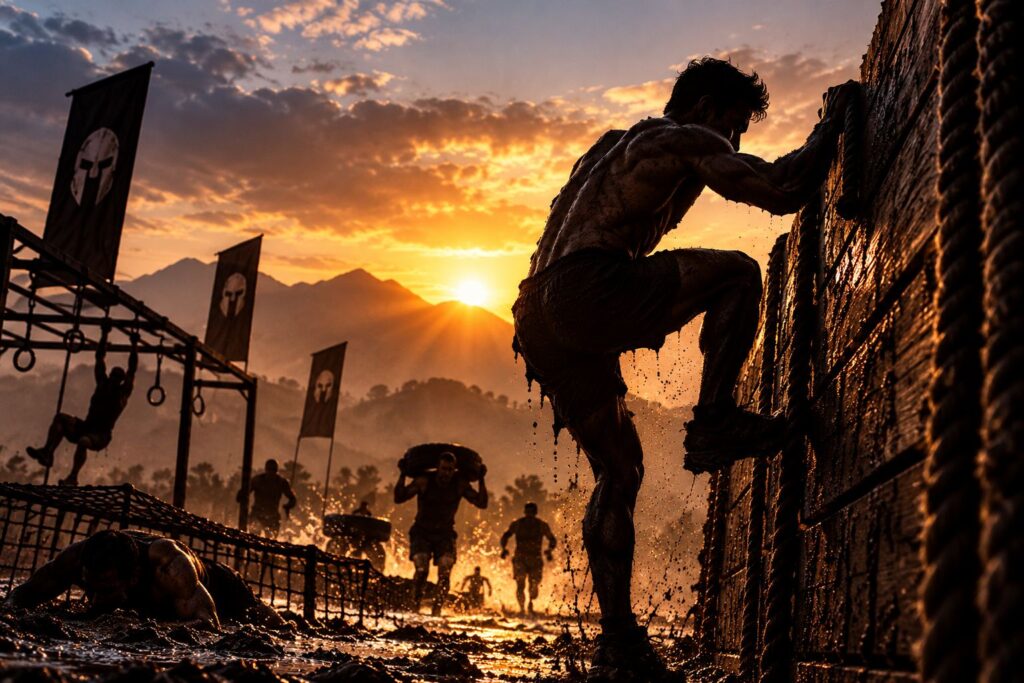
Thinking about taking on the Yoddha Race?
Preparing for an obstacle-based fitness race requires much more than simply running more kilometres or lifting heavier weights. You need a combination of Cardiovascular Endurance, Strength, Muscular Endurance, Grip Strength, Power, Mobility and Mental Resilience to perform well when your body is already fatigued. Whether you’re a first-time participant or an experienced athlete looking to improve your performance, this Yoddha Race training guide will help you understand what to train, how to structure your preparation and how to approach race day.
1. What Is the Yoddha Race?
The Yoddha Race is a demanding fitness challenge that combines running with physically challenging obstacles and functional movements. Unlike a traditional running race, where your primary objective is to maintain running speed, an obstacle race constantly changes the physical demands placed on your body.
You may need to:
Run while fatigued
Climb and pull
Carry external loads
Push or drag resistance
Jump and land
Crawl
Maintain grip under fatigue
Produce short bursts of high-intensity effort
Recover quickly before the next challenge
This means your preparation needs to develop multiple physical qualities simultaneously.
2. What Makes Yoddha Race Training Different?
A common mistake is to train only one quality.
For example:
“I’ll just run because it’s a race.” Or “I’ll just lift heavy because there are obstacles.”
Neither approach is sufficient. Your performance depends on how effectively you can transition between running, strength-based obstacles and high-intensity efforts.
Think of your preparation as developing six major qualities:
1. Aerobic endurance
You need enough cardiovascular capacity to continue moving efficiently for the duration of the event.
2. Strength
Strength helps you overcome obstacles, carry loads and control your body under resistance.
3. Muscular endurance
You may need to perform repeated efforts without allowing your muscles to fatigue excessively.
4. Grip strength
Your hands and forearms can become a limiting factor during hanging, climbing and carrying movements.
5. Power
Jumping, accelerating and rapidly overcoming resistance require the ability to produce force quickly.
6. Mental resilience
Obstacle races are physically uncomfortable. Your ability to remain composed and continue working when fatigued can significantly affect performance.
3. How Long Should You Train for the Yoddha Race?
Your ideal preparation period depends on your current fitness level.
Beginner: 12–16 weeks
If you have limited running, strength-training or obstacle-race experience, give yourself more time to build your foundation.
Focus on:
- Basic running endurance
- Fundamental strength
- Movement quality
- Grip development
- Gradual conditioning
Intermediate: 8–12 weeks
If you already train consistently and can comfortably run and strength train, you can begin combining these qualities more aggressively.
Advanced: 6–8 weeks
Experienced athletes can focus more heavily on race-specific conditioning, obstacle simulations and performance optimization.
More training is not automatically better. Your preparation should progressively increase the training stimulus while allowing sufficient recovery.
4. The Four Pillars of Yoddha Race Training
A well-designed program should combine four major components.
1. Running
Running provides the aerobic foundation of your preparation. Don’t make every run hard.
Use a combination of:
- Easy aerobic runs
- Tempo runs
- Intervals
- Hill running
- Race-pace efforts
- Short recovery runs
Example running structure
Easy run:
30–60 minutes at a conversational intensity.
Interval session:
For example, 6 × 400 m with controlled recovery.
Tempo session:
20–30 minutes at a challenging but sustainable pace.
Long run:
Gradually build duration to improve aerobic capacity and fatigue resistance.
The exact distances and intensities should be adjusted according to your current fitness and race requirements.
2. Strength Training
Strength training should focus on movements that transfer to obstacle racing.
Prioritize:
Lower body
- Squats
- Split squats
- Lunges
- Step-ups
- Deadlifts
- Romanian deadlifts
- Calf raises
Upper body
- Pull-ups
- Rows
- Push-ups
- Bench press
- Overhead press
- Dips
Full body
- Farmer carries
- Sled pushes
- Sled drags
- Sandbag carries
- Kettlebell movements
- Loaded carries
You don’t need to become a powerlifter. The goal is to develop relative strength and usable strength.
3. Functional Conditioning
This is where your gym training begins to resemble the demands of an obstacle race. Instead of training each exercise in isolation, combine movements with minimal recovery.
For example:
Example conditioning circuit: 4 rounds
- 400 m run
- 15 kettlebell swings
- 10 burpees
- 20 m farmer carry
- 10 walking lunges
- 8–10 pull-ups
Rest between rounds as required. The objective isn’t simply to finish the circuit. You are teaching your body to transition between running and resistance-based movements while fatigued.
4. Grip Training
Grip strength is one of the most overlooked components of obstacle-race preparation. Your grip may fail before your larger muscles do.
Include:
- Dead hangs
- Farmer carries
- Suitcase carries
- Towel hangs
- Towel pull-ups
- Heavy rows
- Plate pinches
- Fat-grip holds
Simple grip finisher
After strength training:
3 rounds
- Dead hang: 30–45 seconds
- Farmer carry: 30–40 m
- Plate pinch: 20–30 seconds
Progress gradually. Don’t train your grip to failure every session.
5. Yoddha Race Obstacle Training
You don’t need access to every race obstacle to prepare effectively. Instead, identify the movement pattern involved.
Climbing / pulling
Train:
- Pull-ups
- Rope climbs
- Lat pulldowns
- Rows
- Towel pull-ups
Carrying
Train:
- Farmer carries
- Sandbag carries
- Front carries
- Suitcase carries
Pushing
Train:
- Sled pushes
- Heavy prowler work
- Push-ups
- Leg-drive exercises
Dragging
Train:
- Sled drags
- Rope pulls
- Backward sled drags
Crawling
Train:
- Bear crawls
- Leopard crawls
- Low crawls
Jumping
Train:
- Box jumps
- Broad jumps
- Hurdle jumps
- Squat jumps
The goal is to build the physical qualities behind the obstacle rather than trying to perfectly replicate every obstacle.
6. Sample 7-Day Yoddha Race Training Schedule
A recreational athlete could structure a week like this:
| Day | Training |
|---|---|
| Monday | Easy run + mobility |
| Tuesday | Full-body strength |
| Wednesday | Running intervals + grip |
| Thursday | Recovery / mobility |
| Friday | Strength + carries |
| Saturday | Race-specific conditioning |
| Sunday | Long easy run or recovery |
As race day approaches, the training should become increasingly specific to the demands of the event. Your current fitness level, training history and injury status should determine the actual volume and intensity.
7. Nutrition for Yoddha Race Preparation
Training hard without supporting it nutritionally can compromise recovery and performance.
Your nutrition should provide sufficient:
- Protein
- Carbohydrates
- Dietary fats
- Micronutrients
- Fluids
- Electrolytes
Protein
Protein supports muscle repair and adaptation. A practical target for active individuals is often around 1.6–2.2 g/kg/day, depending on goals, training volume and total energy intake.
Carbohydrates
Carbohydrates are particularly useful for high-intensity and endurance-based training because they support glycogen availability. For demanding race preparation, extremely low carbohydrate intake may make it more difficult to sustain repeated high-intensity efforts for some athletes. Your carbohydrate intake should therefore be individualized according to training volume, body composition goals and metabolic considerations.
Hydration
Don’t wait until race day to think about hydration. Practice your hydration strategy during training. Sweat rate, environmental temperature, humidity and exercise duration all influence fluid and electrolyte requirements.
8. Recovery: The Missing Piece
You don’t improve simply because you train. You improve because your body adapts to training during recovery.
Prioritize:
1. Sleep
Aim for approximately 7–9 hours of quality sleep when possible.
2. Rest days
Recovery days allow accumulated fatigue to dissipate.
3. Mobility
Use mobility work to maintain movement quality and address individual restrictions.
4. Load management
Don’t increase running volume, strength volume and conditioning intensity aggressively at the same time. A common mistake is trying to become race-ready by simply doing more and more work.
9. Race Week: What Should You Do?
The final week should not be about building new fitness. Your goal is to arrive at the start line fresh, fueled and confident. Reduce training volume while maintaining some movement intensity.
Avoid:
New exercises
Extremely heavy lifting
High-volume conditioning
Exhaustive long runs
Aggressive dieting
Continue eating familiar foods and maintain your normal hydration routine.
10. Yoddha Race Day Strategy
Your first objective should be pacing. The excitement of the start can cause athletes to run much faster than their sustainable pace. That can become expensive later.
1. Think
Controlled → Efficient → Aggressive
Start controlled. Move efficiently through obstacles. Increase effort when you know you can sustain it.
2. Don’t waste energy
Obstacle racing rewards efficiency. Avoid unnecessary movements. Use proper technique rather than relying purely on brute force.
3. Control your breathing
After a difficult obstacle, regain control of your breathing before the next major effort. The ability to recover quickly between efforts can become a major performance advantage.
11. Common Yoddha Race Training Mistakes
1: Only running
Running is important, but running alone doesn’t prepare you for obstacles.
2: Only lifting heavy
Maximum strength doesn’t automatically equal strength endurance.
3: Ignoring grip
Grip failure can significantly compromise obstacle performance.
4: Training hard every day
Constant high intensity creates unnecessary fatigue and can increase injury risk.
5: Never practicing transitions
Running immediately followed by a loaded carry feels very different from performing either activity independently. Practice combinations.
6: Changing everything before race day
Race week isn’t the time to experiment with a new diet, supplement, shoe or training method.
12. Beginner vs Advanced Yoddha Race Preparation
Beginner
Focus on:- Building aerobic fitness
- Learning fundamental strength movements
- Developing grip
- Improving movement quality
- Gradually increasing training volume
Intermediate
Focus on:- Strength endurance
- Running intervals
- Carries
- Grip endurance
- Functional circuits
- Race-specific transitions
Advanced
Focus on:- Race-specific intensity
- Pacing strategy
- Obstacle efficiency
- High-level conditioning
- Weak-point development
- Performance optimization
13. Yoddha Race Preparation Checklist
Before race day, you should ideally have:
☐ Built a consistent running base
☐ Developed full-body strength
☐ Trained grip endurance
☐ Practiced loaded carries
☐ Included high-intensity conditioning
☐ Practiced running-to-obstacle transitions
☐ Tested your race-day nutrition
☐ Tested your hydration strategy
☐ Prioritized sleep and recovery
☐ Reduced training volume before race day
☐ Prepared your race equipment
☐ Developed a pacing strategy
Final Takeaway
The Yoddha Race isn’t simply a test of how fast you can run or how much you can lift. It is a test of how well you can Run, Climb, Carry, Push, Pull, Jump & Keep Moving When Fatigue Starts Accumulating.
The best preparation therefore combines:
Endurance + Strength + Muscular Endurance + Grip + Power + Recovery + Race Strategy.
Don’t train harder just for the sake of training harder. Train specifically, progressively and intelligently. And remember, your goal isn’t to become exhausted during training. Your goal is to arrive at the start line prepared to perform.
Ready to Train for Your Yoddha Race?
At Game of Physique, we approach performance training by combining structured strength training, conditioning, mobility and nutrition with a clear progression toward your goal. Whether you’re preparing for an obstacle race, HYROX, endurance event or simply want to build a stronger and more capable body, your training should be designed around the demands of your objective.
Train with purpose. Perform with confidence.
Game of Physique — Private Transformation & Performance Coaching.