EXERCISE MECHANICS
Common Exercise Form Mistakes That Kill Your Gains
Bad form steals tension, kills progress, and increases injury risk — master mechanics before chasing heavier weights.
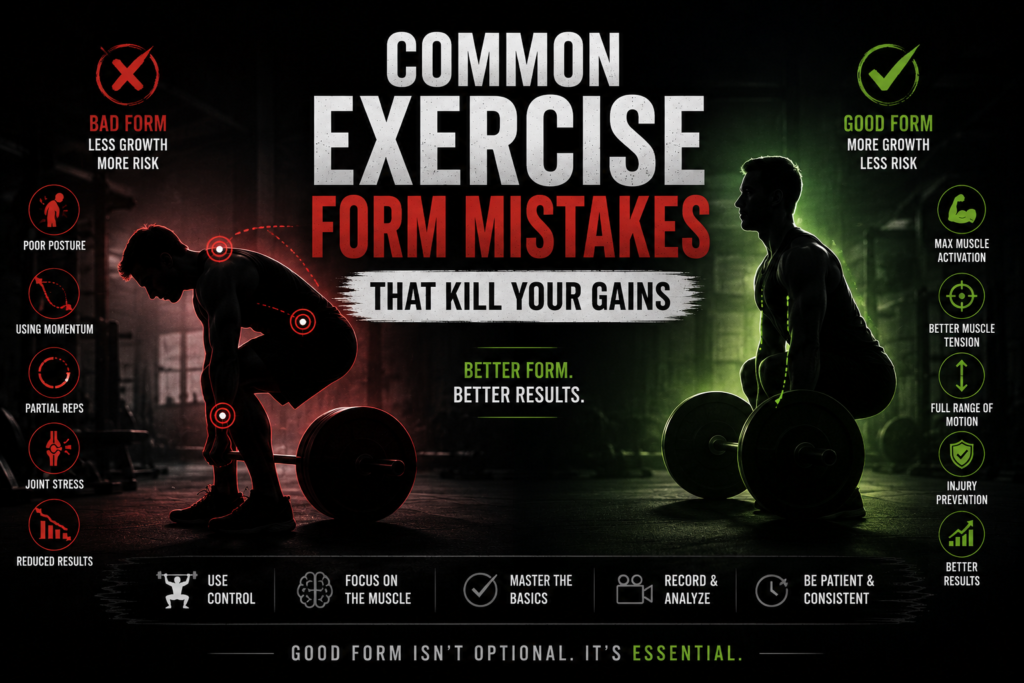
Most people think training harder automatically means better results.
But in reality:
Poor exercise form can completely destroy muscle growth, strength progress, and recovery.
You can spend years in the gym lifting heavy weights and still fail to build the physique you want if your exercise execution is poor.
Because muscles don’t care about:
- Ego
- Momentum
- How much weight is on the bar
They respond to:
Proper tension, mechanics, and controlled execution.
Bad form doesn’t just increase injury risk.
It also reduces the quality of stimulus your muscles receive.
1. Why Exercise Form Matters
Proper form helps:
- Target the intended muscle
- Improve tension quality
- Reduce joint stress
- Increase stability
- Improve long-term progression
Bad form often shifts stress away from muscles and into:
- Joints
- Tendons
- Momentum
- Supporting structures
This makes exercises less effective and more dangerous.
2. Ego Lifting
One of the most common mistakes in gyms everywhere.
People use more weight than they can actually control.
This usually leads to:
- Swinging
- Partial reps
- Poor positioning
- Momentum-based lifting
Yes, the weight moves.
But the target muscle often works less.
A controlled 20 kg rep is usually more effective than a sloppy 35 kg rep.
3. Using Momentum Instead Of Muscle
Momentum steals tension from the target muscle.
Examples:
- Swinging dumbbells during curls
- Bouncing during bench press
- Jerking rows with the lower back
- Using hips to raise lateral raises
Momentum may help move the weight —
but it reduces muscular workload.
The goal is not simply moving weight.
The goal is making the muscle perform the work.
4. Poor Range Of Motion
Half reps are extremely common.
People shorten movements to:
- Lift heavier
- Avoid discomfort
- Chase ego numbers
But poor range of motion reduces:
- Muscle stretch
- Fiber recruitment
- Tension quality
- Hypertrophy stimulus
Training through a safe and controlled full range usually produces better growth.
5. Rushing Repetitions
Fast, uncontrolled reps reduce muscular tension.
Especially during the lowering phase.
The eccentric portion of an exercise:
(The lowering phase)
…is incredibly important for muscle growth.
When reps are rushed:
- Stability decreases
- Muscle control decreases
- Tension decreases
Controlled movement creates better stimulus.
6. Poor Posture And Positioning
Body positioning changes muscle recruitment dramatically.
Examples:
- Rounded lower back during deadlifts
- Elbows flaring excessively during presses
- Poor bracing during squats
- Neck compensation during pulling exercises
Bad positioning creates:
- Force leaks
- Reduced stability
- Joint stress
- Lower performance
Good mechanics allow efficient force production.
7. Ignoring Mind-Muscle Connection
Many people train without actually focusing on the target muscle.
They simply move weight from point A to B.
Mind-muscle connection helps improve:
- Muscle activation
- Tension quality
- Exercise efficiency
The best lifters don’t just lift weights.
They intentionally direct tension into specific muscles.
8. Training Too Heavy Too Early
Beginners often rush into heavy lifting without mastering technique first.
This creates:
- Compensation patterns
- Poor movement habits
- Injury risk
- Slow long-term progress
Strength built on poor mechanics eventually becomes a limitation.
Technique should always come before load progression.
9. Neglecting Stability
Stable positions create stronger contractions.
Lack of stability reduces:
- Force production
- Control
- Muscle recruitment
Common stability mistakes:
- Loose core during compounds
- Poor foot positioning
- Unstable pressing mechanics
- Lack of bracing
Better stability improves:
- Strength
- Safety
- Tension quality
10. Copying Social Media Workouts Blindly
Many flashy exercises online prioritize entertainment over effectiveness.
People imitate:
- Excessive instability
- Random movements
- Unnecessary complexity
- Ego-based lifting
But effective training is usually simple:
- Proper mechanics
- Controlled execution
- Progressive overload
- Consistent tension
Basics build physiques.
Not circus tricks.
11. Ignoring Pain Signals
Pain is not always “weakness leaving the body.”
Sharp pain often signals:
- Poor mechanics
- Joint overload
- Tissue irritation
- Recovery problems
Ignoring pain and pushing harder can turn small issues into serious injuries.
Smart training is sustainable training.
How To Improve Your Exercise Form
- Lower The Weight -> Use loads you can actually control.
- Slow Down Reps -> Especially the eccentric phase.
- Record Your Lifts -> Video analysis reveals mistakes quickly.
- Focus On Tension -> Feel the target muscle working.
- Master Basics First -> Simple movements executed well outperform advanced exercises done poorly.
- Prioritize Consistency -> Good mechanics repeated over time create long-term results.
conclusion
Most people don’t need:
- More exercises
- More intensity
- More complicated programs
They need better execution.
Because poor form doesn’t just increase injury risk.
It also kills muscle tension — and muscle tension is one of the biggest drivers of growth.
The best physiques are built through:
- Precision
- Control
- Proper mechanics
- Consistent execution
Not sloppy ego lifting.
KEY TAKEAWAYS
- The goal isn’t to move the weight.
- The goal is to make the muscle do the work properly.